Send us a text

Text with us!

By submitting this form, you agree to our Terms of Service & Privacy Policy.

K&S Masonry Restoration

Stucco Repair in Brookhaven, PA

Wide view of a stucco wall sitting on a fieldstone base
Cracked, hollow and stained stucco

Is the problem the stucco, or the water behind it?

Stucco repair starts with a question the surface cannot answer alone: is the finish failing, or is water getting behind it? A crack is an opening into the wall assembly, and on many Philadelphia area homes the water that gets in has little way to drain or dry. It sits against the sheathing and framing while the wall looks mostly fine from the street.

That is why hollow sounding patches, staining and soft spots near the base tell us more than the width of any single crack. K&S Masonry Restoration repairs cracked, hollow, stained and failing stucco across Delaware County from our base in Brookhaven, PA. We sound the wall first, find where the water is getting in, and then rebuild only what has actually failed, in coats, with the texture matched to the wall around it.

How we work a wall

  • Sound the wall

    Tapping across the surface finds stucco that has let go of what is behind it, cracked or not. Those areas set the real repair size.

  • Trace the water

    Cracks under windows, at corners or near roof lines usually point to flashing and detailing, which has to be put right or the damage returns.

  • Patch and match

    Failed sections are cut back to sound material and rebuilt in coats, with the finish worked to match the wall around it.

What we look for

Four kinds of stucco failure, and what each one is telling you

The quiet problems matter more than the visible ones. A hairline crack on a sound wall is minor. A wall that looks intact but sounds hollow is not.

Cracks

You see

Fine, evenly spread hairlines, or a crack running diagonally from a window or door corner, or one wide enough to admit water.

It can mean

Evenly spread hairlines are often just the finish coat moving with curing and temperature. Diagonal or bunched cracks point to movement behind the wall or water getting in.

We check

Whether the wall around the crack still sounds solid when tapped.
Hollow spots

You see

Often nothing. The area may look perfect until you tap it and it sounds drummy.

It can mean

The stucco has debonded from the substrate and is effectively a shell. It will eventually crack and fall away.

We check

The whole elevation, not just the spot you noticed, so the true repair area is known before a quote.

Moisture behind stucco

You see

Dark staining, bubbling paint, soft spots near the base, or cracks that keep starting under a windowsill.

It can mean

Missing or failed flashing at an opening, or grade, paving or splashback keeping the bottom of the wall wet.

We check

Where the water is entering, before any patch goes on.

Stucco over stone foundations

You see

Loose or cracked stucco where it meets a fieldstone base, and damp or staining at the foot of the wall.

It can mean

Water working in at the edge where the stucco stops, or open mortar joints in the stone base below it.

We check

The stucco edge and the stone joints together, with the base handled as masonry restoration.

Stucco over stone

Where the stucco meets the stone base

Many Delaware County houses carry stucco above a stone foundation. The stucco and the stone each have to be sound, and so does the line where they meet.

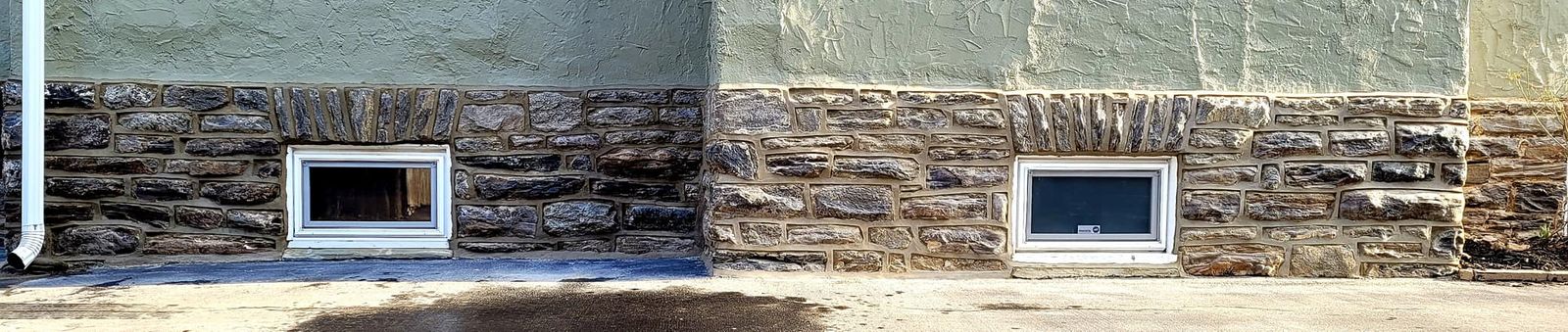
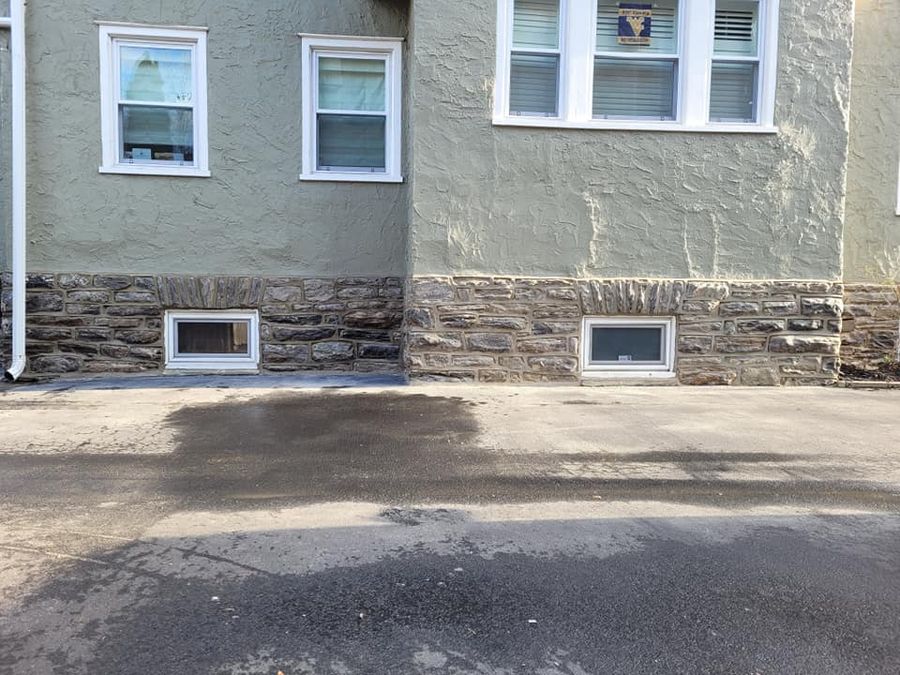
Stucco house with a fieldstone base
Stucco wall above a stone base, the whole elevation in one view.
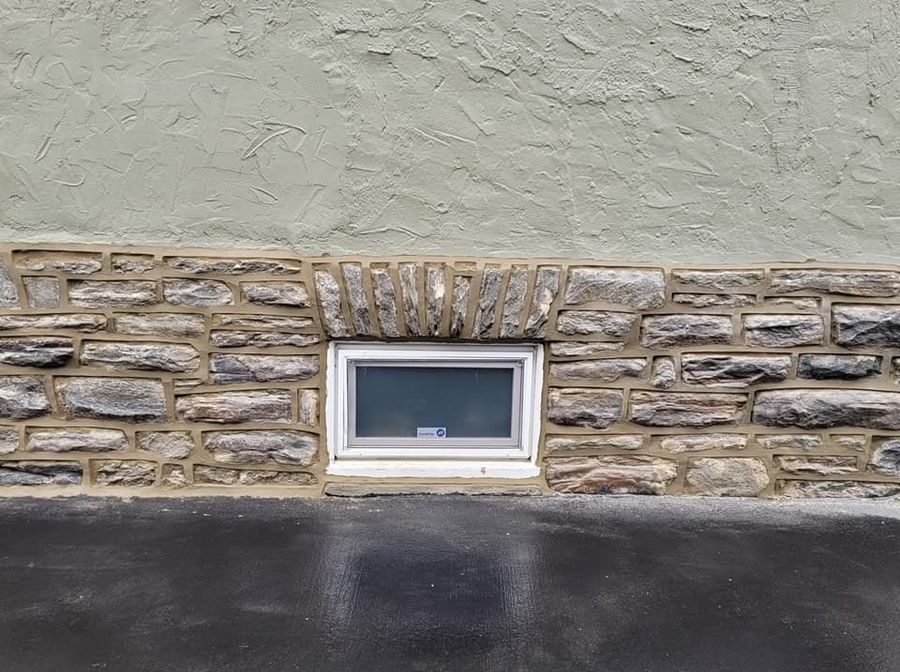
Stucco over a stone base with a basement window
Closer on the transition, with a window opening in the stone base.
Repair or recoat

Patch the damage, or redo the whole wall?

Sounding the wall decides it. Here is how the two options differ.

Targeted repair
Fits when

The damage is local, the rest of the wall sounds solid, and the cause of the water entry has been found.

What it involves

Failed sections cut back to sound material and rebuilt in coats, with the finish worked to match.

What to expect

Patched stucco cures a slightly different shade, so on a painted wall the cleanest result is repainting the full elevation.

Full recoat
Fits when

Hollow or cracked areas are spread across an elevation, or the patches would outnumber the stucco that is still sound.

What it involves

Failed stucco removed across the wall and rebuilt in coats as one continuous surface.

What to expect

One texture and one color across the elevation instead of a wall of patches.

Neither one comes first. The water has to have somewhere else to go before any stucco goes back on, or the same failure returns.

Related work on the same house
Stucco repair questions

What homeowners ask us about stucco

Are cracks in stucco serious?

It depends on the pattern more than the size. Fine, evenly spread hairline cracks are common and often just the finish responding to curing and temperature. Worry more about a crack running diagonally from a window or door corner, a crack wide enough to admit water, or cracking bunched in one spot. Then tap the wall nearby: if it sounds hollow, the repair area is bigger than the visible crack.

What does it mean if my stucco sounds hollow?

It means the stucco has separated from what is behind it and is no longer bonded, so that section is effectively a shell. Water getting behind the finish and breaking the bond is the usual cause, or damage to the lath or sheathing that supports it. Hollow areas tend to crack and fall away eventually, which is why we sound the whole wall before any repair is quoted.

Can stucco be patched so the repair does not show?

Usually, though it means matching both the texture and the flatness of the wall. Repairs are built up in coats, and the final coat has to be worked to match the surrounding float, sand, dash or smooth finish. Color is the other variable, since patched stucco cures a slightly different shade. On a painted wall, repainting the whole elevation looks cleaner than spot painting the patch.

Should I paint or seal my stucco to protect it?

Breathable, masonry appropriate coatings can be fine. Film forming waterproof sealers usually are not, because stucco has to release moisture that gets into the wall, and a coating that blocks vapor traps water behind the finish. If the wall already shows staining or hollow areas, coating over it only hides the symptom. The repair comes first, and the water needs a way out.

How much does stucco repair cost?

The price depends on how much of the wall has failed, how far the hollow areas reach, whether flashing or grade work is part of the cause, and how easy the wall is to reach. We do not name a number without seeing the stucco. Use Get a Quote to tell us what you see on the wall, and we will take it from there.

Stucco repair in Brookhaven, PA

Cracked or hollow stucco? Tell us what you see.

K&S Masonry Restoration works across Delaware County, Montgomery County and Chester County, including Havertown, Drexel Hill, Springfield, Chester, Wayne, Radnor, Ardmore and Philadelphia. Michael and his crew will sound the wall and tell you what is actually failing.